Loading search results…
Loading products…
Planning · October 2026
Boneless can make a quarter cow box about 18 pounds lighter. You did not lose any steak. You lost bone.
Here is the cut sheet question that makes people second guess everything.
Bone-in or boneless?
Most people pick boneless because it sounds like “more meat.” Then the boxes show up lighter and they feel robbed.
They were not robbed. The meat is the same. The bone is what left.
Your quarter hangs at about 180 lb. That number includes bone, fat, and water.
SDSU Extension says the butcher turns 60 to 70% of the carcass into cuts. Which end you land on is mostly your bone choices.
| Cut style | Hanging | Yield | Box weight |
|---|---|---|---|
| Mostly bone-in | 180 lb hanging | ~70% | ~126 lb box |
| Mostly boneless | 180 lb hanging | ~60% | ~108 lb box |
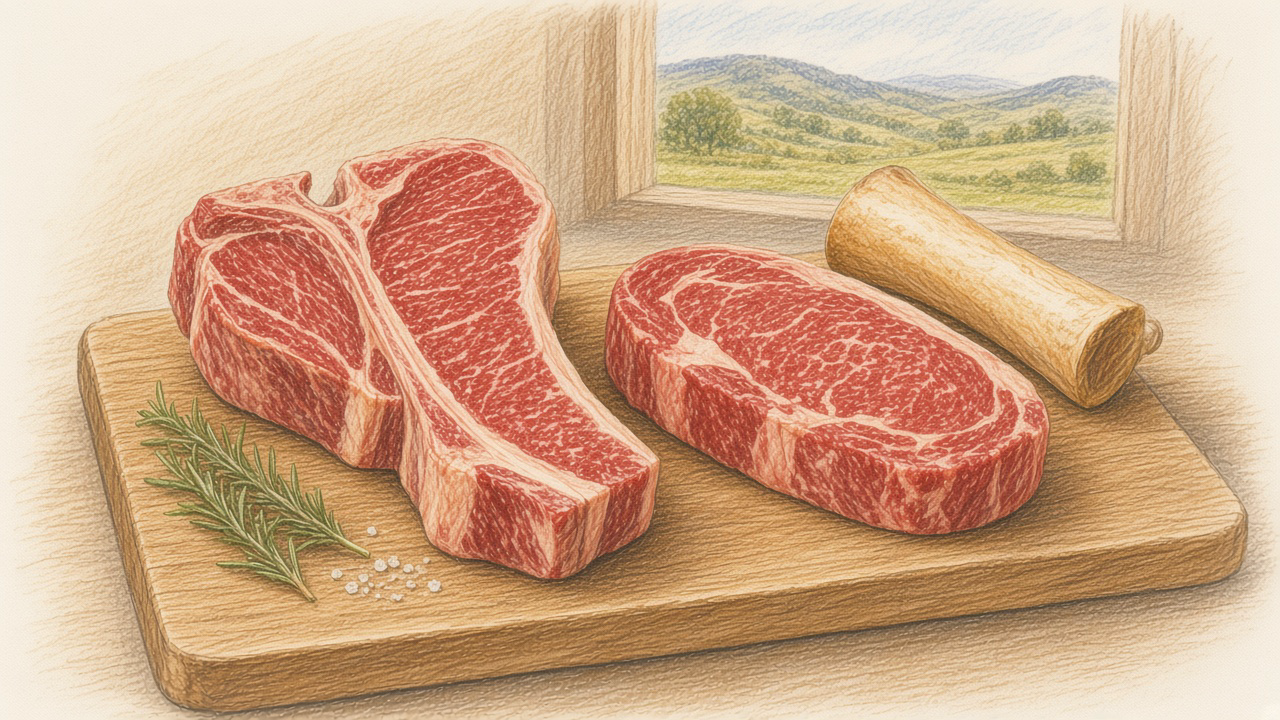
Bone is about 15% of a carcass. On a 180 lb quarter that is roughly 27 lb of bone. Go bone-in and some of it rides home in your ribeyes, T-bones, and 7-bone roasts. Go boneless and it stays at the locker.
For the full live, hanging, take-home breakdown, see what hanging weight is.
Most farms bill on hanging weight. So the cut sheet does not change your bill.
Say your quarter runs about $1,000 all-in. Bone-in box: ~$7.94 a pound. Boneless box: ~$9.26 a pound.
Same steer. Same money. Same meat to eat. The boneless number just looks worse on paper.
This is the trap when you compare a farm to the grocery store. See the real price per pound of a quarter cow.
Our eighth cow is about 50 lb of 100% grass-fed beef, $749 all-in with shipping. Fixed cut mix. No locker math.
Buy the eighth cow shareKansas State ran the test in 2022. Same carcasses, bone-in vs boneless steaks, then they weighed what was left to eat.
| Cut | Bone-in edible lean | Boneless edible lean |
|---|---|---|
| Ribeye | 47.1% | 60.3% |
| Strip | 41.2% | 54.5% |
| Tenderloin | 42.0% | 67.6% |
Edible lean as a percent of raw steak weight. Farmer et al. 2022, Meat and Muscle Biology.
That gap is bone (and the fat around it). On a ribeye, boneless gives you about 13 more points of edible meat per raw pound.
So at the grocery store, a bone-in ribeye only wins if it is at least ~22% cheaper than boneless. If boneless Choice ribeye is $15.97 a pound (Sam's Club, October 2026), bone-in needs to be about $12.47 or less to be the same deal. Strips need about 24% off. Anything with tenderloin on the bone needs about 38%.
We already ran the warehouse aisle against a farm box in Sam's Club beef vs buying from a farm.
A little. Sometimes.
K-State's trained panel scored bone-in ribeyes and bone-in tenderloins as more flavorful. Tenderness and juiciness did not move.
Then they asked regular people. Consumers rated bone-in and boneless the same on flavor and tenderness for every cut. The one win: bone-in strips came out juicier and better overall.
Bone-in also cooks slower. The bone-in ribeye took about 11.4 minutes vs about 8.9 for boneless on the same setup. That is fine on a Saturday. Less fine at 6:45 on a Tuesday.
Not every line on the sheet is a big deal. These are the ones that move pounds and dinners.
The rest of the sheet gets covered in how to read a cut sheet.
That 18 lb is roughly one cubic foot of freezer at our 5 to 7 cu ft quarter rule. See how much freezer space a quarter cow needs.
Boneless packs stack flatter. Bone edges can also poke holes in vacuum bags, which is how freezer burn sneaks in.
If your freezer is tight, go boneless on roasts and keep bone-in only where you care: ribeyes or T-bones.
The Freezer Report is a $4.99 shortlist of quarter, half, and whole cow farms near you. One page. Farms ranked. Not a concierge call.
Get the Freezer ReportMonthly Access is $6.99/month for the full catalog of farm products near you.
Get Monthly AccessOr skip the cut sheet. Buy the eighth.
About 50 lb of 100% grass-fed beef, $749 all-in with shipping. Or start with a $4.99 farm shortlist, or $6.99/mo to see every farm product near you.