Loading search results…
Loading products…
Beef shares · November 2026
Two or three. Sometimes zero. Here is why the count is small, and what to ask for if you want them.
You are filling out a cut sheet and you see the line. T-bone and porterhouse. You picture a freezer with a stack of them.
Then you count. A quarter cow gives you two or three bone-in loin steaks. Total. That is not a typo and it is not your farm being stingy. There is only so much tenderloin on one side of a steer.
Here is the honest count, why the number is small, and how to get the most out of that short loin if porterhouse is what you want.
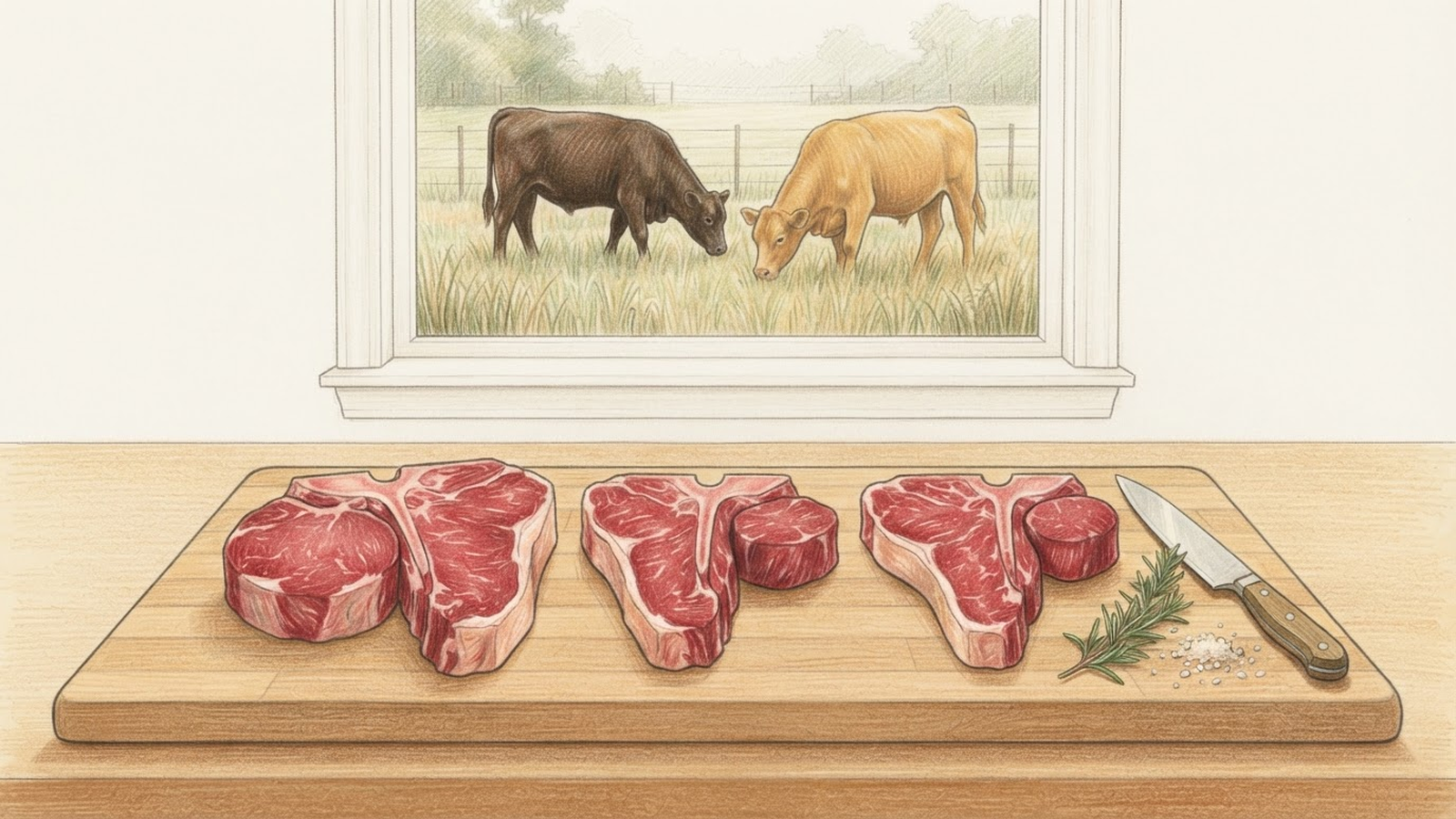
A steer has two short loins, one on each side. A quarter cow is one side, so you get one loin. A loin sawed bone in gives you a few steaks, not a dozen.
| Share | Bone-in loin steaks | Approx. lb | Note |
|---|---|---|---|
| Eighth cow | 0 to 1 | None to about 2 lb | Often no short loin at all. Usually steaks from the rib and sirloin. |
| Quarter cow | 2 to 3 | About 4 to 8 lb bone in | One short loin, cut bone in. A mix of porterhouse and T-bone. |
| Half cow | 4 to 6 | About 8 to 16 lb bone in | Two short loins, one per side. |
| Whole cow | 8 to 12 | About 16 to 32 lb bone in | Four short loins. You will be bored of them before they run out. |
If your farm cuts the loin into boneless strips instead, the same meat becomes 8 to 12 NY strips. Same beef, more pieces, no bone. You picked one lane or the other on the cut sheet.
A whole tenderloin runs about 4 to 5 lb on a big steer. Half of that lives under the short loin. Only a few inches of it are thick enough to count as porterhouse.
The trade rule is simple. 1.25 inches of filet on the far side of the bone makes it a porterhouse. Anything thinner is a T-bone. Same cut, same bone, same grill. One just has more filet hanging off the back.
That is why a quarter lands two or three and not ten. The short loin is roughly 1 to 1.5 percent of the carcass on each side. It is a small piece of a big animal.
The full breakdown of the two names is in porterhouse vs T-bone on a cut sheet. If you only want the strip side, go read how many NY strips in a quarter cow.
You cannot make more porterhouses appear. You can decide how the loin is cut, and that changes what lands in the freezer.
| On the sheet | What you get | The trade |
|---|---|---|
| Leave the loin bone in | 2 or 3 porterhouse or T-bone steaks | Biggest plate presence. The bone is 0.2 to 0.3 lb you pay for. |
| Cut the loin into NY strips | 8 to 12 boneless strip steaks | More meals, no filet side, no bone weight. |
| Tenderloin separate, strip as steaks | Filet steaks plus boneless strips | Two clean cuts, zero bone-in steaks. Best pounds per dollar. |
My take. If you are feeding two people, bone in wins on the plate. If you are feeding four, strips stretch further. And if you want the best pounds per dollar, ask for the tenderloin separate.
Write “thick” if you want the porterhouse end and “thin” if you want more T-bones to feed one person. No butcher can promise a label until the loin is sawed. They can aim for it.
Two porterhouses out of 100 to 125 lb of take-home beef sounds silly. Then you look at the rest of the box.
The porterhouse is the steak night flex. The ground beef is what actually runs out first. That is true in every share size. See how much ground beef in a quarter cow if you are planning around that.
The Field & Cattle eighth is about 50 lb of 100% grass fed beef for $749 all in, shipped. Fixed cut mix. Steaks, ground, roasts. No forms, no deposit.
Buy the eighth cow share →If the quote sounds too good, the number is probably hanging weight, not take-home.
The Freezer Report is $4.99 for a ranked shortlist of quarter, half, and whole cow farms in your area. Compare before you fill out anyone's cut sheet.
Get the Freezer Report →$6.99 a month gets you Monthly Access. Every eighth, quarter, half, and whole cow near you in one place, with cut details.
Get Monthly Access →Or start with the eighth. $749 shipped.