
Loading search results…
Loading products…
Getting started · September 2026
About 4–10 packages. Usually ~6–8 on a default sheet. Roughly 12–20 lb if you keep chuck and round as roasts instead of grinding them. Here's the cut-by-cut math and how the cut sheet moves it.
People obsess over the steaks.
That's the movie. Ribeyes on Saturday. A freezer that looks like a steakhouse. Ground beef is the footnote they mention so the math sounds responsible.
Then the boxes land. You find a stack of thick packages with names you skipped on the cut sheet. Chuck roast. Rump roast. Maybe an arm roast with a bone staring at you.
That's the middle act. Not the steakhouse fantasy. Not taco Tuesday. Sunday dinner. The cuts that sit in a Dutch oven for three hours and feed six people.
A quarter cow take-home is 100–125 lb. Steaks are 15–25 lb. Ground is 70–80 lb. Roasts, ribs, and the rest fill about 15–20 lb — unless you grind the chuck and round, in which case that roast stack disappears into the burger pile. Same animal. Different freezer. Let's count the packages.
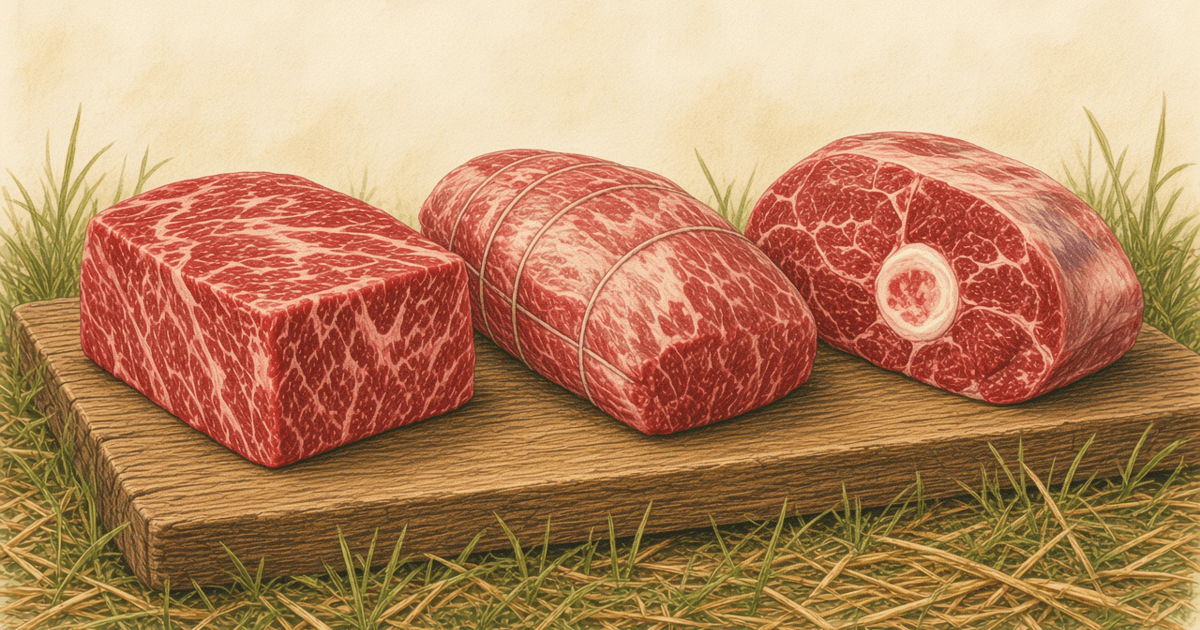
A standard quarter cow cut sheet produces about 4–10 roast packages. Typical default: roughly 6–8 packages / ~12–20 lb of roast meat when chuck and round stay as roasts instead of going into the grind. The spread is wide because two things move it:
On a default locker sheet that still keeps those primals as roasts, most people land in the 6–8 package band. That is not a rounding error. That is the Sunday-dinner inventory.
These are package ranges, not lab science. Lockers pack 2–4 lb bricks. Animals vary. If a line says 0, that cut got ground, cubed, or never requested.
| Cut | Packages | Notes |
|---|---|---|
| Chuck roast | 2–4 | The big one. Grind this and you lose most of the roast stack. |
| Rump / bottom round roast | 1–3 | Leaner. Pot roast, sliced leftover sandwiches. |
| Sirloin tip roast | 0–2 | Easy to lose to steaks or stew if you don't write roast |
| Arm / shoulder roast | 0–2 | Often bone-in. Same chuck neighborhood as the square roast |
| Brisket kept whole | 0–1 | Counts as a roast for a lot of buyers. Split or ground if you skip it. |
| Typical total | 4–10 pkg | Usually ~6–8 / ~12–20 lb if chuck and round stay as roasts |
Full cut-by-cut weights live in our quarter cow meat breakdown. The hanging-weight vs take-home gap is in what is hanging weight.
This is the part people miss until the second order.
A cow is not a roast factory with some burger attached. Chuck and round are the bulk. Default sheets often grind a lot of that because Tuesday tacos are easier than a three-hour braise. Keep those primals as roasts and you pull meat out of the 70–80 lb ground pile. Grind them and the roast count dies.
That 15–20 lb roast/ribs bucket is the rest of a 100–125 lb take-home after steaks and ground. Keep chuck as roasts and more of it shows up as Sunday dinner. Grind chuck and that bucket shrinks while the burger bags grow.
We walk the burger math in how much ground beef in a quarter cow and the steak count in how many steaks in a quarter cow. You cannot max all three. The animal only has so much meat.
Our eighth cow starter share is about 50 lb, 100% grass-fed, $749 all-in with shipping. Fixed cut mix. Roasts included. No locker math.
Buy the eighth cow share →The 4–10 figure is a default. It is not a law.
A cut sheet tells the butcher what to do with each primal. Three lines matter more than the rest if you actually want roast night.
This is the big lever. Grind chuck and the roast count tanks. Keep it as roasts and you pull meat out of the 70–80 lb ground pile on purpose.
Bone-in arm and chuck roasts look bigger and cook juicier. Boneless packs flatter in the freezer. Same meat. Different shape.
Ask for 2–3 lb roasts if you cook for two. 4 lb bricks feed a crowd and take forever to thaw. Write the size. Lockers guess if you don't.
If you leave the sheet blank, the locker picks a generic mix. That mix often grinds more chuck than you wanted. Walk the lines in our cut sheet guide before you sign anything.
Say you land 7 roast packages. Family of four. You do a Sunday roast twice a month.
That's three and a half months of roast nights from the roast stack alone. You will not run out in a week. You might get bored if every pack is the same chuck brick. Rotate the cuts and it feels like a plan instead of leftover pot roast forever.
Sample rotation (7 packages)
A quarter still needs about 5–7 cubic feet of freezer. Roasts are bulky packages. They eat space faster than 1 lb ground bags. Measure before pickup day — freezer space for a quarter cow and how to store a quarter or half cow.
The Freezer Report is a $4.99 ranked shortlist of quarter, half, and whole cow options in your area. One page. No farm directory rabbit holes.
Get the Freezer Report →A quarter usually lands $800–$1,200 all-in for 100–125 lb take-home. That is about $6–$10/lb across everything. Ribeyes included. Chuck roast included.
Grocery chuck roast is often in the $10–$14/lb band, and grass-fed on that shelf runs higher. Whole Foods chuck we priced was $11.99/lb and it was not even labeled grass-fed. Costco conventional chuck can look cheaper on a Sunday. Then you still buy steaks separately. Then you still buy ground separately.
The trick people miss: you are not paying roast prices for 15 pounds and steak prices for 20. You are paying one blended number for the whole animal. The ground is what makes $6–$10/lb possible. The roasts are the middle act grocery chuck never ships with a ribeye attached.
If 125 lb still feels like too much freezer, start smaller. The eighth share above is built for that. If you want local farms ranked for a real quarter, use the report.
$6.99/month unlocks the full catalog of farm beef options near you — every quarter, half, and whole cow available in your area.